Global Politics
PM Modi-Iran Meeting: Why the US Is Watching India’s Iran Ties
Published On:
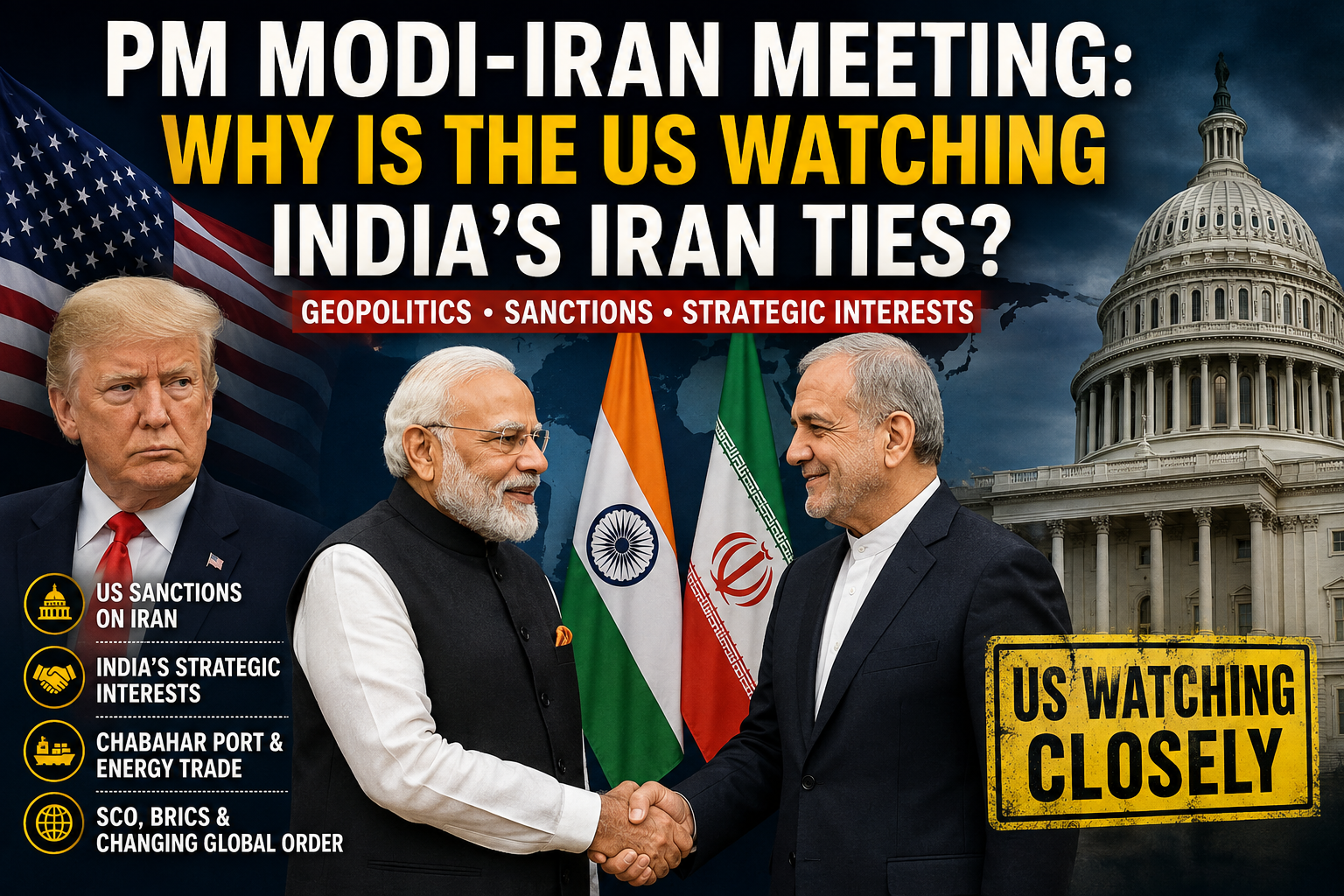
Prime Minister Narendra Modi’s meeting with Iranian President Masoud Pezeshkian has attracted attention in the United States, particularly amid Washington’s ongoing efforts to increase economic pressure on Tehran.
The meeting has raised questions in US media about India’s relationship with Iran, possible trade and energy cooperation, and whether Washington could put additional pressure on New Delhi over its engagement with Tehran.
Why Is the PM Modi-Iran Meeting Important?
Prime Minister Narendra Modi recently met Iranian President Masoud Pezeshkian at an international summit. The interaction comes at a sensitive time as the United States continues its campaign to economically isolate Iran.
US media coverage has focused on the apparent contrast between Washington’s sanctions policy toward Iran and India’s continued engagement with Tehran.
However, India has its own economic, energy and strategic interests in maintaining relations with Iran.
US Sanctions on Iran: What Is Washington Trying to Do?
The United States has been increasing economic pressure on Iran through sanctions and measures designed to restrict Tehran’s access to international trade and revenue.
According to the discussion in the source material, US officials have warned countries against helping Iran establish mechanisms that could generate revenue for the Iranian government.
Washington’s broader argument is that Iranian revenue could potentially support military capabilities and its nuclear programme.
This makes countries doing business with Iran particularly important to US policymakers.
Why Is Iran Important for India?
India-Iran relations extend beyond conventional trade.
Iran has strategic importance for India because of energy interests, regional connectivity and India’s broader engagement with Central Asia.
The Chabahar Port is particularly important in this context, giving India a strategic route toward Afghanistan and Central Asian markets.
Therefore, completely distancing itself from Iran would not necessarily be an easy option for New Delhi.
What Did Marco Rubio Say About India and Iran?
US Secretary of State Marco Rubio was questioned about India’s engagement with Iran.
The response, as reflected in the source transcript, emphasized the US position that countries should not help Iran create economic mechanisms that generate revenue for Tehran.
The US has repeatedly argued that countries engaging with Iran need to consider the implications of sanctions and Iran-related economic activity.
However, India’s engagement with Iran does not automatically mean that New Delhi and Washington are heading toward a major diplomatic confrontation.
India and the US continue to share broader strategic interests, particularly in the Indo-Pacific.
Is China the Biggest Challenge to US Pressure on Iran?
China represents another major factor in the US strategy toward Iran.
The source material highlights China’s continuing economic and energy relationship with Iran. China has purchased significant quantities of Iranian oil and has maintained other forms of economic and strategic cooperation with Tehran.
This creates a challenge for Washington.
If China continues substantial economic engagement with Iran, isolating Tehran through sanctions becomes considerably more difficult.
Could US Pressure on India Increase?
The possibility of greater US pressure on India cannot be ruled out if Washington further intensifies its sanctions campaign against Iran.
India could find itself having to balance two sets of interests: its growing strategic partnership with the United States and its longstanding economic and strategic interests involving Iran.
This is where India’s policy of strategic autonomy could become increasingly important.
New Delhi has traditionally attempted to maintain relationships with multiple major powers rather than completely aligning itself with one geopolitical bloc.
Why Are SCO and BRICS Important?
India’s participation in organisations such as the Shanghai Cooperation Organisation (SCO) and BRICS adds another dimension to the situation.
These platforms bring India together with countries including Russia, China and Iran.
The source suggests that increasing geopolitical tensions could lead to pressure on India to reduce its engagement with Iran through such multilateral organisations.
However, doing so would be complicated because these platforms are also important to India’s broader diplomatic and economic interests.
Could India, Russia and China Create Alternative Payment Mechanisms?
Another important issue raised in the source material is the possibility of developing payment mechanisms that could reduce dependence on US-controlled financial systems.
Russia has reportedly discussed greater financial cooperation among India, Russia and China in the context of reducing exposure to Western sanctions.
If alternative payment mechanisms expand, they could potentially make economic sanctions less effective.
However, the development and implementation of such systems would be a complex process involving financial, regulatory and geopolitical challenges.
What Happens If Iran Retaliates?
The situation could become even more complicated if Iran launches major retaliatory attacks following military strikes.
The transcript discusses concerns that Iran could target US-linked interests or countries in the Gulf region rather than directly attacking the United States.
Any major escalation involving Iran, Israel, the US and Gulf countries could have consequences for global energy markets and international trade.
For India, instability in the Gulf region would be particularly important because of its energy requirements and the large Indian community living across the Gulf.
Will the India-US Relationship Be Affected?
The Iran issue could become a sensitive point in India-US relations, but it is unlikely to be the only factor determining the relationship.
India and the US have significant cooperation across defence, technology, trade and the Indo-Pacific.
At the same time, India has demonstrated that it wants to maintain independent relationships with countries such as Russia and Iran.
The key challenge for New Delhi will therefore be maintaining its strategic autonomy while avoiding unnecessary confrontation with Washington.
What Could Happen Next?
The coming weeks and months could be important for India, Iran and the United States.
If Washington increases sanctions on Iran, pressure could also grow on countries and companies maintaining commercial relationships with Tehran.
India may then have to carefully evaluate its energy, trade and connectivity interests while taking US sanctions into account.
At the same time, developments involving China, Russia, SCO and BRICS could influence the broader geopolitical balance.
Conclusion
The PM Modi-Iran meeting is significant because it comes at a time of rising tensions between Iran and the United States.
For India, the challenge is not simply choosing between Washington and Tehran. New Delhi must protect its own economic and strategic interests while maintaining its growing partnership with the United States.
The larger issue is therefore India’s ability to maintain strategic autonomy in an increasingly divided global order.
As tensions surrounding Iran, the US, Israel, China and Russia continue to evolve, India’s diplomatic balancing act is likely to receive increasing international attention.
Recent Post