Technology
Google Pixel 11 Series: 10 Biggest New Features, Specs and Price
Published On:
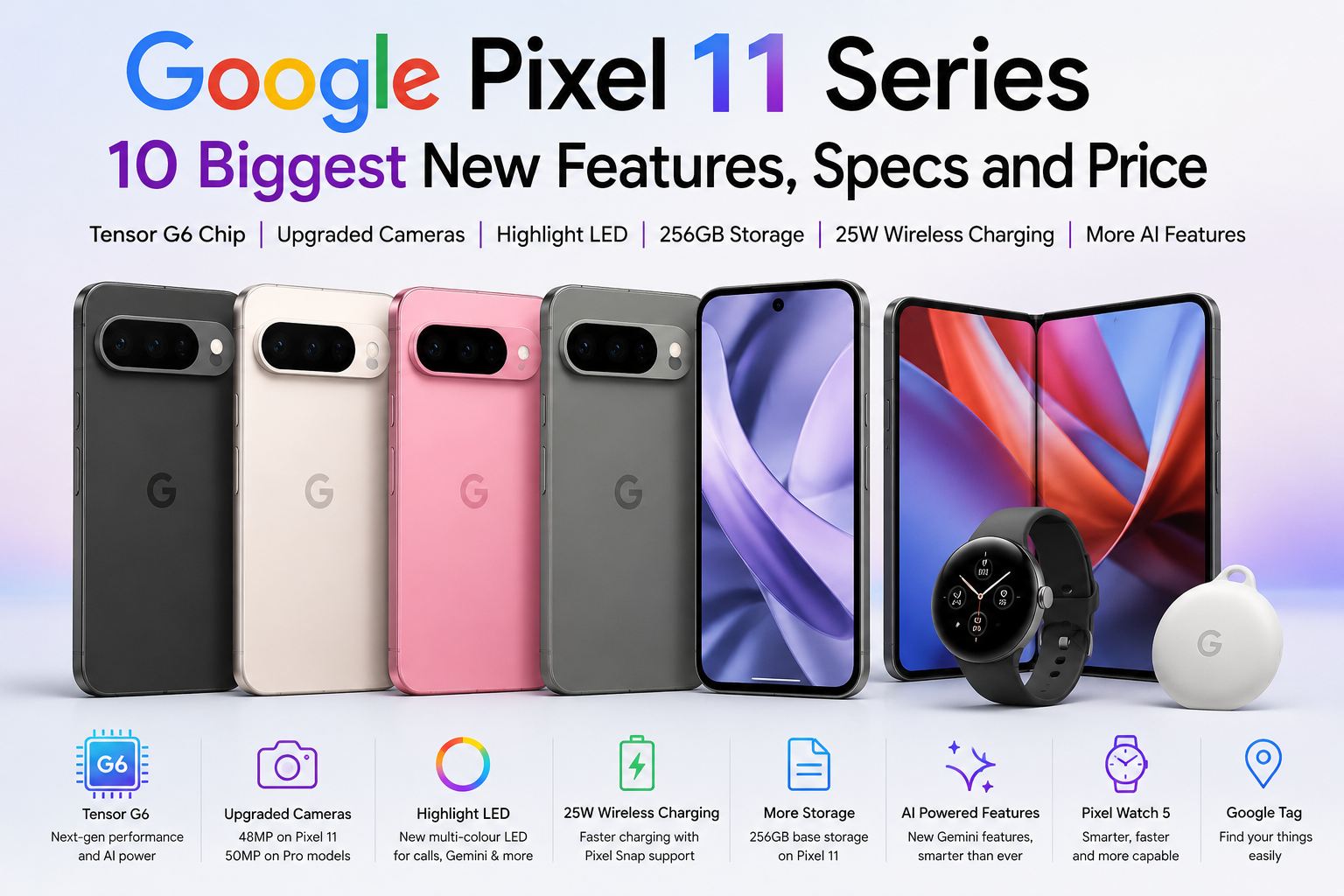
Google has unveiled its new Pixel 11 series, including the Pixel 11, Pixel 11 Pro, Pixel 11 Pro XL and Pixel 11 Pro Fold. The new generation brings upgraded cameras, Google’s latest Tensor G6 processor, brighter displays, faster wireless charging and several new AI-powered features.
However, the Pixel 11 lineup appears to follow Google’s familiar strategy: instead of introducing a radical hardware redesign, the company has focused on incremental hardware improvements and expanding the software and AI experience.
One of the most talked-about additions is a new rear LED feature called Highlight, while the Pro models receive larger camera sensors and brighter displays. At the same time, Google has increased prices for several models.
Here is everything you need to know about the Google Pixel 11 series.
Google Pixel 11 Series: What’s New?
The Pixel 11 lineup retains the recognizable Pixel design while introducing several hardware and software upgrades.
The biggest changes include:
- New Google Tensor G6 chipset
- Highlight rear LED feature
- Upgraded camera sensors
- 256GB base storage on the Pixel 11
- Faster 25W wireless charging
- Brighter Super Actua displays on Pro models
- New Pixel 11 Pro Fold hinge
- More AI-powered features
- New Pixel Watch 5
- New Google Tag tracking accessory
Despite these upgrades, the overall design language remains familiar.
Google Pixel 11 Gets a New Highlight LED
One of the most unusual additions to the Pixel 11 series is a new multi-coloured LED positioned alongside the camera flash.
Google calls the feature Highlight.
The LED can glow in different colours and is designed to interact with features such as Gemini and incoming calls. Users can customize certain behaviours through the system settings.
However, the functionality appears relatively limited at launch.
The Highlight light can be used when interacting with Gemini or when a specific contact calls, but it does not function as a general-purpose notification light for messages and third-party applications.
This makes the feature interesting from a hardware perspective, although its usefulness may depend heavily on how Google expands its capabilities in the future.
Google Pixel 11 Specifications and Camera Upgrade
The standard Pixel 11 maintains Google’s familiar Pixel silhouette while receiving several hardware improvements.
The phone features a new 48-megapixel primary camera sensor, along with an ultrawide camera and a 5x telephoto camera.
Google has also reduced the protrusion of the camera bump, allowing the first-party case to blend more closely with the rear of the phone.
The larger primary sensor could potentially improve photography, particularly in challenging lighting conditions. However, real-world camera performance will ultimately depend on Google’s image-processing software as well as the new sensor hardware.
The Pixel 11 also comes with 12GB of RAM and the new Tensor G6 processor.
Pixel 11 Storage and Price Increase
One of the major changes to the base Pixel 11 is its storage configuration.
Google has effectively removed the previous 128GB entry-level configuration and moved the base model to 256GB of storage.
However, that change comes with a higher starting price.
According to the supplied information, the Pixel 11 starts at $899, compared with the previous $799 entry point.
That means buyers receive twice the base storage, but the entry price is also $100 higher.
Pixel 11 Gets Faster Wireless Charging
Wireless charging has also received an upgrade.
The Pixel 11 now supports 25W wireless charging, compared with 15W previously.
Google has also retained Pixel Snap magnetic compatibility, giving users access to magnetic accessories and charging solutions.
However, the Pixel 11 does not appear to introduce extremely fast wired charging or the much larger battery technologies found in some competing flagship smartphones.
Google Pixel 11 Pro and Pixel 11 Pro XL
The Pixel 11 Pro series continue to come in two sizes:
- Pixel 11 Pro – 6.3-inch display
- Pixel 11 Pro XL – 6.8-inch display
The overall design remains recognizable, but Google has redesigned parts of the camera bar.
The rear camera system now uses an edge-to-edge glass design across the camera area instead of the previous cutout arrangement.
Pixel 11 Pro Camera Upgrades
The Pixel 11 Pro gets a new 50-megapixel primary camera sensor measuring approximately 1/1.3 inches.
The larger sensor is designed to capture more light and could deliver improved image quality.
The Pro models also feature:
- 50MP main camera
- 48MP telephoto camera
- 48MP ultrawide camera
The camera hardware represents one of the more significant upgrades in the Pixel 11 Pro lineup, although Google’s computational photography and AI processing will remain an important part of the overall experience.
Pixel 11 Pro Display Gets Brighter
The Pixel 11 Pro and Pro XL continue using Google’s Super Actua display technology.
The resolution, screen size and refresh-rate specifications do not receive a major change, but brightness has increased.
The display can reportedly reach a peak brightness of 3,600 nits, compared with approximately 2,200 nits on the previous generation.
That should make the phone easier to view outdoors and under bright lighting conditions.
Pixel 11 Pro RAM and Pricing
One controversial change concerns RAM.
The Pixel 10 Pro reportedly started at ₹94,440 with 16GB of RAM. The Pixel 11 Pro starts at approximately ₹103,884, but the 256GB model comes with 12GB of RAM.
The 512GB and 1TB configurations retain 16GB of RAM.
The Pixel 11 Pro XL starts at approximately ₹ 122,772.
This means buyers looking for more RAM may need to move to a higher-storage configuration, making the premium models considerably more expensive.
Google Pixel 11 Pro Fold: What’s New?
The Pixel 11 Pro Fold is Google’s latest foldable smartphone and receives several upgrades over its predecessor.
It includes:
- Tensor G6 processor
- New camera system
- Highlight rear LED
- 48MP main camera
- Faster wireless charging
- Brighter displays
- Redesigned hinge mechanism
- Slightly slimmer design
- Reduced inner display bezels
- IP68 dust and water resistance
The new hinge is one of the hardware changes, but the overall improvement is relatively subtle.
The new foldable is approximately 1mm thinner and slightly lighter, while the internal display bezels have also been reduced.
Pixel 11 Pro Fold Price
The Pixel 11 Pro Fold starts at approximately ₹179,342 for the 256GB version, representing a $100 increase over the previous generation.
Google has also introduced a new composite glass fiber back-cover material that is intended to provide greater resistance to cracking and breaking.
The phone retains an IP68 dust and water-resistance rating, which remains an important advantage in the foldable smartphone segment.
Pixel 11 Pro Fold vs Other Foldables
The Pixel 11 Pro Fold retains Google’s distinctive foldable form factor, which can make the phone particularly appealing for users who prefer its screen proportions.
However, the new generation does not appear to make a major leap in thickness or crease reduction compared with some competing foldable phones.
The crease remains visible, although it can become less noticeable while consuming content.
For buyers paying close to ₹179,437, competition in the premium foldable segment could therefore be intense.
Tensor G6 and Google’s AI Strategy
The Tensor G6 chipset is at the heart of the Pixel 11 series.
Rather than competing purely on raw processor performance, Google continues to emphasize artificial intelligence and software features.
Gemini is deeply integrated into the Pixel experience, while the company is also introducing new camera and AI capabilities.
One interesting feature is a teleprompter mode integrated into the camera. Users can enter text and have it automatically scroll according to their speaking speed while recording video.
This could be particularly useful for creators, vloggers and people recording videos for social media.
Google is also highlighting faster Night Sight processing and smoother zoom while recording 8K video.
Google Pixel 11 Software Features
Google’s software remains one of the biggest reasons to choose a Pixel smartphone.
Features such as Call Screening and Now Playing have historically differentiated Pixel devices from competing Android phones.
With the Pixel 11 generation, Google is pushing Gemini further into the smartphone experience.
The company’s approach remains clear: Pixel devices may not always lead the market in charging speed, battery capacity or raw hardware specifications, but Google’s software and AI capabilities are designed to provide a different type of flagship experience.
Google Pixel Watch 5 Announced
Google has also introduced the Pixel Watch 5 alongside the Pixel 11 smartphone lineup.
The design remains similar to previous Pixel Watch generations, but Google has upgraded the internal hardware.
The Pixel Watch 5 uses a new Snapdragon W5 Gen 2 chip, which Google says delivers approximately 12% faster CPU performance.
The smartwatch also receives around 50% more on-device RAM, supporting additional AI-related functions.
These include:
- Generative watch faces
- Gemini interactions
- Wrist-based Gemini conversations
- Workout-related features
- Improved GPS accuracy
The Pixel Watch 5 is priced at approximately ₹37,682 and ₹40,516, depending on the size.
Google Tag: Air Tag Alternative for Android Users
Google has also announced a new tracking accessory called Google Tag.
The device is designed to help users locate belongings through Google’s Find Hub network.
Because Find Hub uses the wider Android ecosystem, compatible Android devices can contribute to the network used to locate lost items.
Google Tag can also work with Gemini to help users find their belongings.
The device is priced at approximately ₹2,738. for one unit or ₹9,349 for a four-pack.
The product is expected to ship in November.
Is the Google Pixel 11 a Major Upgrade?
The Pixel 11 series represent an evolution rather than a complete reinvention.
Google has upgraded important components including cameras, the Tensor processor, wireless charging and display brightness.
However, several areas remain relatively conservative.
The company has not made a major push toward extremely fast charging, dramatically larger batteries or radically thinner foldables.
Instead, Google continues to differentiate Pixel phones through software, AI and computational photography.
That strategy has been part of the Pixel identity for years.
Google Pixel 11: Should You Buy It?
For consumers looking for the latest Pixel experience, the standard Pixel 11 may be the most compelling option in the lineup.
The move to 256GB of base storage, upgraded cameras, Tensor G6 and faster wireless charging makes the base model more attractive.
The Pixel 11 Pro and Pro XL offer better displays and more advanced camera hardware, but their higher prices make the value proposition less straightforward.
The Pixel 11 Pro Fold remains targeted at buyers who specifically want a premium foldable phone. Its improved hinge, thinner body, brighter displays and upgraded camera system are useful improvements, but the high starting price means buyers will have to carefully compare it with rival foldables.
The Google Pixel 11 series continue Google’s long-running Pixel philosophy: focus heavily on software, AI and smart features rather than simply chasing the biggest hardware numbers.
The new cameras, Tensor G6 chip, brighter displays, faster wireless charging and improved foldable design make the Pixel 11 lineup more capable than its predecessor.
But the higher prices and relatively incremental hardware upgrades could make the new Pixels a harder sell for existing Pixel 10 owners.
For new buyers, however, the standard Pixel 11 could emerge as the most attractive model, particularly because of its 256GB starting storage and upgraded camera system.
The Pro models and Pixel 11 Pro Fold are aimed at users willing to pay a premium for better cameras, displays and form factors.
Ultimately, the Pixel 11 may not represent the dramatic hardware revolution some fans were hoping for but Google’s software and AI ecosystem remains the defining reason to consider a Pixel.
Recent Post